About Fundació

This author has not yet filled in any details.
So far Fundació has created 1495 blog entries.

MOSAICS 3rd CYCLE. IMAGE OF THE MUSES

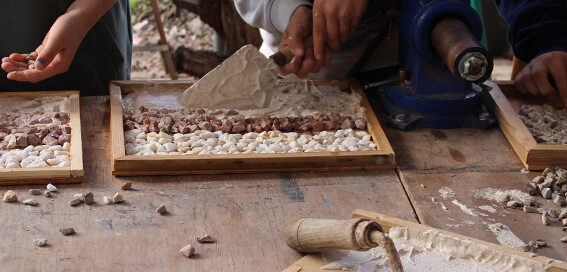
It is believed that the origin of the mosaic technique dates back to more than 3000 years BC in Mesopotamia, although it was developed and refined in ancient Greece, reaching its peak in the elaborate Roman mosaics and the Byzantine Empire. The word mosaic means “work inspired by the muses”, divinities of the Arts. The making of a mosaic follows very specific steps, being a very complete process that includes design, ingenuity, creativity and technique. Pebbles, stones of different sizes or uniform tesserae are used depending on the effect you want to achieve and mortars such as lime or plaster. Originally the support was the floor or the wall. In this case we have used a wooden board with a frame to contain the plaster that is applied at the end of the process. We have taken inspiration from original ornaments from Persia, Greece and Rome.
2024-02-02T09:00:27+00:00February 2nd, 2024|

2nd AND 3rd YEAR ESO. BIOLOGY

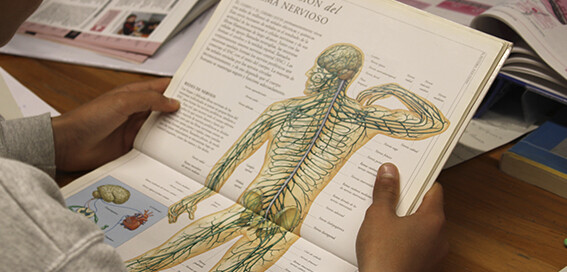
The 2nd and 3rd year secondary school (ESO) group has immersed themselves for four weeks in a Biology learning period. Through daily reading of the book "The Secret Life of Trees" by Wohlleben, we have been able to discover the hidden world of trees: what they feel, what they communicate. We have also given life to the study of human biology from the mechanism to the organism, investigating through questions about the eyes and sight, hearing and listening, the sense of balance, the sense of touch, taste and smell, the sense of movement, the larynx and speech, the human skeleton and the nervous system. Why do we see the sky blue? What organ is involved in the vision of ambiguous figures? What is the path of sound? What helps us maintain balance? What is pain? What is touch? How are taste and smell related? Do you know why you can move without thinking about what to do at any given moment? How is the sound of the voice generated? How many types of bones does our skeleton have? What is the arch of our feet used for? Why does the column have a wavy shape? How does the brain develop from birth? and a long etc. Various sources have accompanied the path of research, study and learning: books, articles, drawings, a skeleton and a torso, but above all the desire to learn to learn. Every week different groups of students have presented their micro-research projects and answered their classmates' questions. On Thursdays we have held debates on science and society topics, in order to develop skills such as argumentation, critical thinking or decision making, active listening, oratory and oral expression: Is it possible that Artificial Intelligence will end humanity? Do human beings behave like a parasite on Earth? Are GMOs our salvation or our downfall? On February 2 we close the period with an oral presentation of the personal research project that each one has chosen within the field of Biology. Some of the projects will reveal to us: What is Nature's secret number? How dolphins sing? What are reflections? What does microbiology study? Why, if we theoretically come from monkeys, do monkeys not become human beings over time? "Knowledge takes up no place." Aristotle.  

2024-02-06T08:49:16+00:00February 2nd, 2024|

CRAFTS 1rs YEAR OF ESO. SNEAKERS

  The 1st year ESO students, in artistic processes, have been making their own shoes. To do this, they have calculated the shape and size of the shoes by first making the cardboard insole and also the upper part. Then they have chosen different fabrics for their design. They started by hand sewing the parts of the shoes and then finished them with the sewing machine. Using the sewing machine offers ample opportunity to practice foot rhythm coordination (will), manual dexterity (feeling), and attention (thinking).

2024-02-02T08:50:39+00:00February 2nd, 2024|

CLAY 2nd AND 3rd YEAR OF ESO. WHAT IS THE ETERNAL IN YOU?

The period of biology has been the source of inspiration for this process of modeling with clay, and in a broad way, the vital forces that model concave and convex shapes in a harmonious dialogue, reflected in the human face and head. The novelty and challenge has arisen from the technique used to create the heads, created from a hollow shape that is modeled from within, to bring out the elements of the face. Each modeled head is different in its expressiveness, and its countenance carries a message. Transcending the physical, we ask; What is eternal in you? What is eternal in me? In this way we finish the process in an artistic-poetic environment that gives us profound answers.

2024-02-02T10:01:51+00:00February 2nd, 2024|

JOANA SOCÍAS. ENGLISH LITERATURE IN SECONDARY EDUCATION

My name is Joana Socías and I was born in Mallorca. After an intense year of study, I have just completed a Master's Degree in Secondary and Baccalaureate Teacher Training with a specialization in Foreign Language Teaching (English). In addition, I have a degree in Audiovisual Communication from the European University of Madrid (2001), a degree in Political Science from the Complutense University of Madrid (2005) and a Master's degree in Art, Culture and Literature from the Open University of Catalunya (2019). I am also doing the Postgraduate course in Holistic Pedagogy in Sa Llavor and this will be the fourth year that I will be accompanying secondary students. Next week we will begin the unit of The power of words (English literature) with the 2nd and 3rd year secondary students. At the end of February, I will be with the 1st year secondary students where we will study the first explorers of Africa and Asia. So that you can get to know me a little better, I worked for four years in a newspaper in Madrid and for three years I was a freelance journalist in Kenya (Africa). I have written two books and I am very passionate about reading, languages and words. I feel very lucky to be a part of an educational project like this.  

2024-02-02T08:38:55+00:00February 2nd, 2024|

CONFERENCE WORKSHOP FOR THE EDUCATIVE COMMUNITY. THE BODY, TECHNOLOGY AND SPIRITUALITY.

Conference Thursday, February 15 from 4 to 6 p.m. On Thursday, February 15, we will hold the conference workshop The body, technology and Spirituality in Sa Llavor. Navigating the second migration. The conference will be open to the public and will focus on the problems of children, adolescents and young people in front of the screen (and also adults). Topics such as intimacy, exposure on the networks, concentration and dispersion, consequences and possible solutions will be discussed. It will be carried out by Hernán Melana, writer and teacher in Waldorf schools for twenty years. He has been coordinator of training and seminars for Waldorf teachers in Latin America and Spain, professor at the University of Living Sciences of Madrid, president of the 27 de Febrero Foundation, founder and coordinator of the Casa de los Jóvenes Foundation, vice president of the Federation of Waldorf Schools and Initiatives and representative of the Argentine Waldorf Schools Network, author of plays for students and of the digital channel "Philosophy, Psychology, Stories" with more than eleven million views.  

2024-02-06T09:30:32+00:00February 2nd, 2024|

KITCHEN: SECONDARY SUPPORT

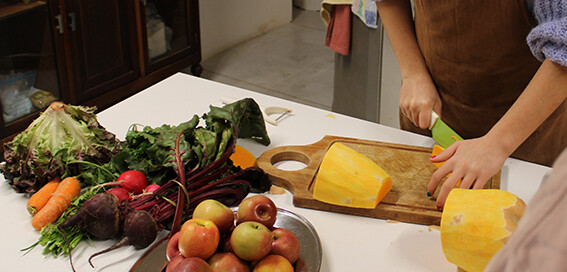
Since January, every morning, two secondary school students participate in the tasks of preparing food for the school cafeteria. Thus recovering the original project of the Sa Llavor kitchen and contributing, with their collaboration, to the service of the community.

2024-02-02T08:28:29+00:00February 2nd, 2024|

OPEN DOORS – CHRISTMAS MARKET

This Saturday, November 16 from 11 a.m. to 3:30 p.m. we are celebrating an open day and Christmas Market at the Fundació Sa Llavor. We invite you to participate, share and celebrate in community. Activity schedule: 11am Doors opening 11:15 a.m. Musical welcome 11:30 a.m. Guided tour of the school 11:30-14h Workshops for families 11:30-12:30h Gamelan Workshop 11:30 a.m.-2 p.m. Silent auction 12:30-3 p.m. Sa Llavor Menu 1-2:30 p.m. Musical entertainment 2:30 p.m.-3 p.m. Theatre 3-3:30 p.m. Swing for everyone And  you will also find: -Pedagogical material station -Artisan stalls -Tea shop cafeteria We are waiting for you in the gardens of the Fundació Sa Llavor, Plaça Metge Borràs 3 in Binissalem. All proceeds will go to the Fundació Sa Llavor forest project. Thank you very much for your collaboration.

2023-12-12T11:32:59+00:00December 12th, 2023|

OPEN ACTIVITY OF SOCIAL EURYTHMY

We invite you to participate in the activity open to the public of Social Eurythmy that we will celebrate next Friday, December 1st from 7:00 p.m. to 8:30 p.m. and Saturday, December 2nd. from 10 a.m. to 12:30 p.m. in Sa Llavor within the Educating City week in Binissalem. Social Eurythmy offers dynamics of conscious movement for the management and coordination of the needs that arise in the development of social and business organizations, with the aim of generating growth and health at an individual and social level. By social organism we mean all companies or associations, or other organized context, such as teams, associations, study groups, etc., in which several people come together to achieve something that would not otherwise be possible. We will have Teresa Mazzei, consultant and social eurhythmist, with more than 20 years of experience in this innovative field of management and coordination of human teams. What does social mean? What is healthy on an individual and social level? Development of social and business organizations. How to deal with changes. Aimed at anyone interested in developing personal, social, organizational skills and learning about social organisms through a living and dynamic approach. Limited capacity. It is essential to confirm attendance to: escolacultura@sallavor.es

2023-11-22T12:51:06+00:00November 22nd, 2023|

NEASC PREPARATORY VISIT

This week Fundació Sa Llavor hosted a two day visit, as part of our ongoing NEASC accreditation process by two professionals: Kevin Glass and Stephanie Packer.   It is the second visit we have hosted so far, and an important step, as a positive result would allow us to be formally recognised by NEASC and would mark the beginning of an ongoing partnership with their organisation.   We are delighted to report that, although we still await a formal written approval (to be received over the coming weeks), we were assured by both our visitors that the outcome would most definitely be a positive one. In fact their feedback was so wonderful to hear that we felt we should celebrate and share some of what they said with the learning community right away. Stephanie told us that in just two days, she had been able to see just how the schools core values and identity are reflected in our students calm and confident attitudes, our teaching staff's natural and friendly relationship with the students, as well as in the wonderful and unique learning environment we have created. That she could feel peace and stability and a true sense of community. Kevin then added that despite having visited hundreds of schools in the past it was truly rare to see one with such clear values and ongoing dedication to a shared belief of what learning should look like. He went on to say that he had no doubt the remaining criteria for full accreditation was mostly already obvious to him and that it would just be down to the pedagogical team to highlight and evidence it over the coming months.   Needless to say, we are delighted with such high praise from two professionals who are dedicated to evaluating high quality learning experiences. We would also like to say a special thanks to all the parents and students that took part in the interviews and request your continued support in an information gathering survey we will be sending out in the near future.   NEASC's accreditation process is a transformative process designed to offer their schools opportunities for self reflection and ongoing growth. It includes a commitment by the schools they work with to develop 10 learning principles, offer and commit to an individualised definition of High quality learning and then produce several learning plans to help grow each school inline with its own ethos.   If you would like to find out more about the ACE pathways, please visit https://www.neasc.org/ace

2023-11-22T10:16:30+00:00November 22nd, 2023|
Go to Top